Five practical tips that office-based businesses can adopt to reduce their environmental and social impact.
1. Procurement 2. Conserve electricity 3. Circular solutions 4. Waste review 5. Go digital
Are you aiming to create a more sustainably responsible workplace? While sustainability at work may seem daunting or costly, it is best achieved through a collective effort, taking a series of small, deliberate steps toward a common goal.
At OfficeMax, we are committed to social and environmental responsibility through our Sustainability Strategy.
We are progressing our strategy through initiatives such as adopting a low-emission fleet (including forklifts), installing solar panels at our Auckland distribution centre, and partnering with charitable organisations to redirect and repurpose unsellable stock.
In New Zealand, customers expect businesses to be more sustainable, but not all companies have the resources or budgets to implement big projects. This article highlights our key learnings in transitioning to a more sustainable workplace.
1. How to make your procurement more sustainable:
The first step to more sustainable procurement is to take a deep dive into how the business spends its money and on what - this allows us to identify opportunities to save money and create a positive impact.
Next, clarify your business's procurement sustainability objectives. Develop these objectives based on the largest impact areas identified in the first step. Clear objectives help you focus on improvements in your procurement practices.
Once you have identified your priority areas for sustainable procurement, inform your procurement team accordingly. You can also work directly with your OfficeMax Account Manager to create a customised category for your organisation, restricting procurement to approved products and suppliers that support your goals.
OfficeMax is here to help – see below how our EcoMax-tagged products can help you create a positive impact through your purchasing.
Social certifications
On the OfficeMax website, you can filter by ‘Social Good’, which includes products that create social, cultural, and/or environmental benefits. This includes:
- Products that are manufactured in New Zealand
- Social enterprise – creating meaningful employment (e.g. Will&Able) and supporting ethical sourcing and manufacturing (e.g. Fairtrade, Trade Aid, Good Common Coffee, Karma Drinks)
- Maori/Pasifika-owned businesses – OfficeMax is a member of this group that facilitates connections with Maori and Pasifika business owners (e.g. Tuhi Stationery). By establishing these supply relationships, we can identify opportunities to procure their services or to offer their products to our customers. Your organisation may also benefit from joining Amotai to strengthen supplier diversity.
Environmental certifications
On the OfficeMax website, you can use the EcoMax filter to sort products by various environmental criteria that suit your business's needs.
- Recyclable product - to help with your waste diversion targets
- Recycled content - supports goals to reduce virgin material use
- Compostable – supports waste diversion, but check if your provider accepts compostable products/packaging before buying
- Carbon and environmental certifications – support organisations actively working to reduce the environmental impact of their operations and/or products
When choosing products, consider high-quality options to achieve long-term cost savings and reduce landfill waste by minimising the need for replacements.
Selecting products from suppliers that offer warranties or allow returns for repairs or recycling will reduce your environmental footprint. For example, Accent Furniture offers a 15-year warranty on its furniture, which includes repair and recycling services on the customer's behalf when the furniture reaches the end of its life. OfficeMax has made it easier to identify these suppliers — check out our new page here: OfficeMax Partnerships Supplier Programmes
Reduce your freight emissions
- As an OfficeMax customer, you can receive carbon-compatible reporting for your freight. This provides you with greater transparency around the environmental impact of your orders and can be included in your organisation's carbon emissions calculation.
- Consider how you typically place orders for items you purchase regularly. Small, frequent orders are likely to have higher freight-related emissions than larger, less frequent orders.
2. Conserve electricity:
Our offices and all the appliances within them are primarily powered by electricity. Whilst we can be proud of New Zealand's largely renewable energy base, it is still important to conserve power. Electricity production and consumption significantly contribute to your business's carbon emissions and costs.
- AC/Heating units: Set a consistent temperature and avoid frequent changes. Make sure your units are regularly maintained.
- Energy-efficient devices: Use energy-efficient products. LED bulbs, high-energy-rated appliances such as microwaves, dishwashers, laptops, and monitors. Install sensor lights where practical.
- Stop, snooze, switch off: If not in use, switch it off. Lights, monitors, laptops, printers, and laminators. Devices in sleep mode still consume energy!
- Service equipment regularly: Unserviced equipment can consume energy and pose a fire hazard.
- Make the most of natural lighting - it’s sustainable and free!
- Signage and awareness: Provide reminder signs for your people and engage with them on the benefits of efficient energy consumption.

3. Circular solutions:
Donate to extend the life of products:
If items are not at the end of their life, there are organisations across New Zealand that would love to repair or redistribute these items for you.
- All Heart NZ – OfficeMax is an impact partner and diverts over 25,000 kg of damaged and obsolete stock through All Heart NZ when we replace items in a customer’s office, such as furniture.
- Ronald McDonald House Charities and Mercy Hospice – OfficeMax donates unsaleable but usable food items to these charities.
- Recycle A Device (RAD) – OfficeMax partners with RAD to offer our customers a service for disposing of their corporate devices. These devices are then redistributed into the community, closing the digital equity gap for young minds in Aotearoa.
- Consider partnering with a local charity to divert donatable items from the landfill.
Recycle to reduce landfill waste
The opportunities to recycle waste streams in New Zealand are plentiful. OfficeMax has set an annual waste diversion target of 85%, which we achieve through our various waste management providers. OfficeMax has taken great strides in diverting waste from landfills for our corporate and warehouse waste streams. The following outlines the various recycling waste streams available to our people, enabling us to achieve our target.
- Food waste, commingled recycling, plastic wrap, polystyrene, cardboard, paper, steel, wooden pallets, e-waste
Contact your provider for more ways to divert waste from the landfill.
4. Improving waste diversion through smarter signage :
Are you noticing that the waste bins in your office are contaminated, and have you noticed the signage around them? It might be time to ask the following questions:
- Can you avoid single-use items? At OfficeMax, we have eliminated single-use coffee cups and disposable cutlery at our in-house cafeteria. Identify any single-use items in your office and assess whether they can be removed.
- Can you remove desk bins? Remove desk bins to discourage the accumulation of large amounts of rubbish and encourage your staff to dispose of waste in a centralised location with clear signage. This will improve knowledge of waste diversion.
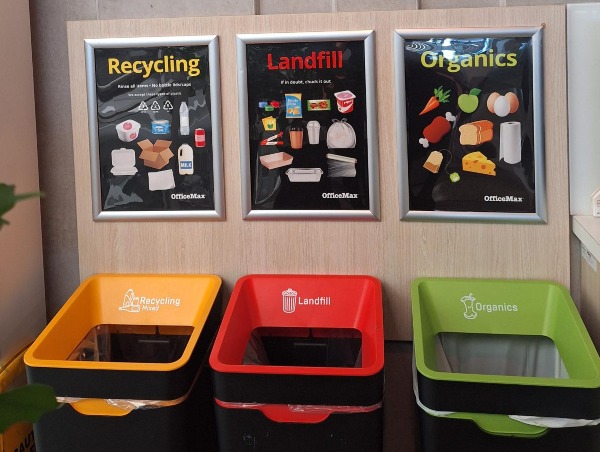
- Does your current signage make sense? When it comes to signage, less is more. Image-centric signs with fewer words are easier to digest and understand at a glance. In 2024, OfficeMax revamped our internal bin signage to make it easier to read (see image below).
- Where is your signage? It makes the most sense to have signs at eye level to increase the likelihood they are seen. Having signage low on the bin itself is less likely to be seen.
- Are you making the signage yourself? Make sure to refer to your waste providers' resources and information on what goes where. Note: different regions accept different items in commingled recycling and compost bins. If you have any doubts, you can ask your waste provider account manager to provide feedback on what you have developed.
5. Go digital:
- Use e-notebook apps such as OneNote, Trello, and Google Workspace on your devices instead of physical notebooks
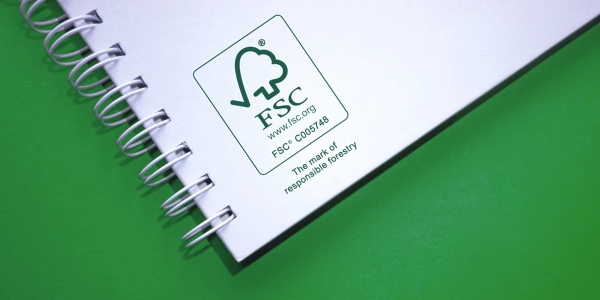
- When purchasing notebooks or paper, procure Forest Stewardship Council (FSC) or Programme for the Endorsement of Forest Certification (PEFC) certified products – you can filter by this in EcoMax
- Print only if necessary, and use double-sided or booklet printing to reduce paper consumption
- When printing, consider grayscale instead of colour to save ink and reduce cost
Learn more about how OfficeMax is improving sustainability to help businesses achieve long-term environmental and financial goals. Check out our Sustainability story here: OfficeMax Sustainability
About the author:
Andrea Topp is OfficeMax’s Senior Sustainability Advisor. With a background in carbon auditing and sustainability consulting, Andrea brings deep knowledge and genuine passion for helping people live and work more sustainably. Andrea is focused on building a culture of kaitiakitanga across OfficeMax, inspiring everyday actions that lead to lasting change.